FAQ
Frequently Asked Questions
How does this project help reduce migration? In what ways could it impact the local economy? What types of fish are raised in the ponds? Does sandponics farming work for all vegetables and crops? How is the money of this project managed? Given the scale of this project, it’s understandable that there are still some open questions. On this page we try to answer al your questions.
About our system
What types of fish are raised in this system?
We can raise both tilapia and African catfish. These species are native, so there is no need to import fish, and there is no risk of harming the environment by introducing invasive species. Both tilapia and vundu (African catfish) are easy to breed and are more resistant to disease compared to many other fish species. Even shrimp are a serious option to try in one of our tanks during the pilot project.
Why is the conventional aquaponics system not applicable?
Traditional aquaponics systems are expensive to operate because they rely on costly, power-dependent filtration equipment. This type of equipment is often unavailable in low-income countries. Our challenge was to design a system that is simple to build, affordable, and made from locally available materials so that anyone can construct and use it.
The impact
Where are you now and what are the next steps of this project?
On our Roadmap you can exactly see where we are now, and what are challenges are for the coming year.
How does this project affect the local economy?
Implementing this project on a large scale would bring significant change to Kartong, the village where we plan to launch it. Because the system does not depend on seasons, crops can be grown and harvested year-round. This allows us to offer stable, year-round employment instead of work limited to certain seasons.
The project also creates a variety of skilled and semi-skilled jobs, including soldier fly farming, plant preparation in nurseries, and the production of grow pipes. We will train teams to help households install these systems in their own gardens. In addition, workers will be needed for transportation, harvesting, and selling of products.
Once fully operational, this project will generate a large number of jobs and long-term economic opportunities for the community.
How does this project affect the ground water levels?
As more farmers in Kartong transition to aquaponics and sandponics, the benefits will extend far beyond higher crop yields. Currently, many residents must rely on wells to water their gardens, often exceeding what the soil can sustainably provide.
These innovative farming systems use a closed-loop design that continuously recycles water, eliminating the need to carry heavy buckets or water multiple times a day. This not only helps restore and maintain groundwater levels but also transforms daily life—reducing labor, saving time, and improving overall community well-being. By adopting sustainable farming, Kartong has the opportunity to set a model for environmentally responsible agriculture that delivers both economic and social impact.
Foundation
How are the funds managed?
Your funds are securely managed in the Netherlands through our foundation. Whenever building materials are needed, we purchase them directly from local suppliers in The Gambia to support the local economy. Only materials that are not available locally will be imported.
How did you meet?
This foundation was established by two individuals: Kevin de Zwart and Musa Bah. In 2012, Kevin decided to kayak the River Gambia, where he met Musa Bah, who joined the journey along with Jerreh Manneh. Their adventure on the river was intense—nearly attacked by hippos, the men had to save each other’s lives, forging a lifelong bond. They survived the river, but the experience left a lasting impact on Kevin.
After the journey, Kevin felt a strong desire to give back—not only to the friends who had saved his life, but also to the countless young people who today risk everything to travel to Europe. This vision became the foundation for a project that Kevin and Musa have been developing for years, focused on creating opportunities and hope for the next generation.
How did you come up with this idea?
After their kayak journey along the River Gambia, the team was shocked by what they witnessed particularly the massive forest fires caused by people burning their land, believing it would make the soil more fertile.
For over five years, Kevin researched farming solutions, as well as ways to make homes climate-resilient. He discovered that aquaponics is highly effective for producing food in dry areas while conserving water. However, applying these techniques successfully for the poorest communities posed real challenges, such as:
How can water be filtered and maintained without money for a filtration system?
How can 2,000 fish be fed without funds for fish feed?
How can a water pump be built without access to electricity?
How can we built a house that can withstand almost every climate disaster?
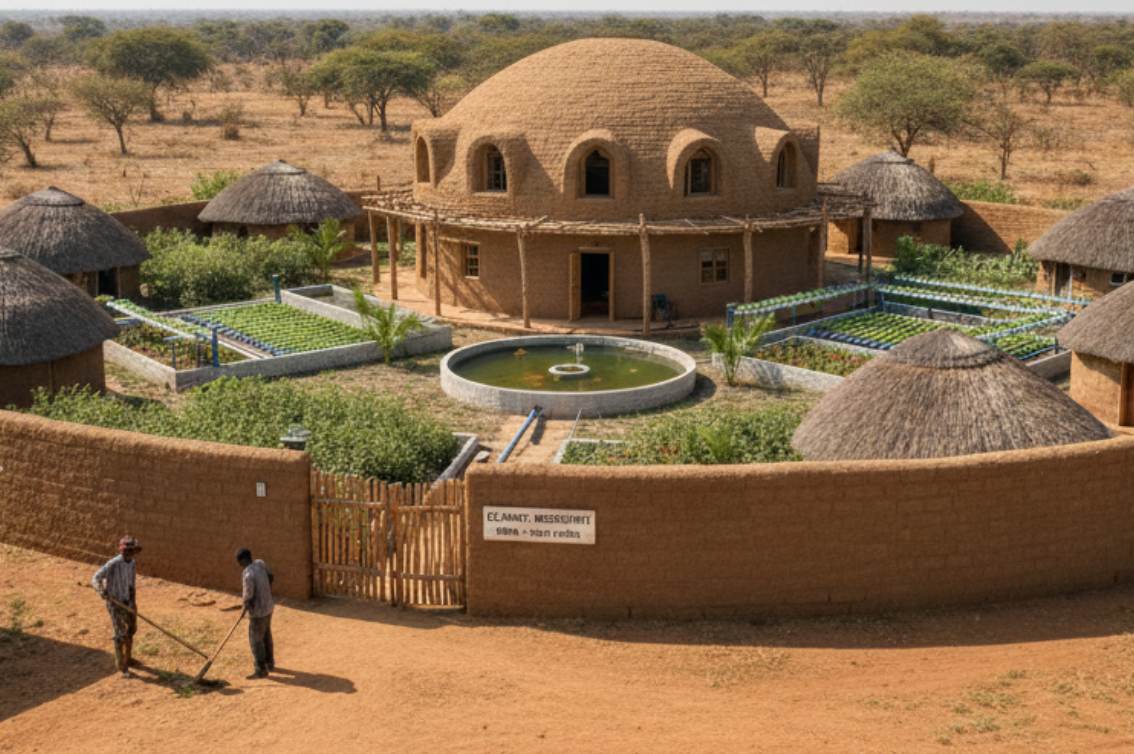
These questions needed answers. In our new design, which we call “The Farm of the Future,” we found practical solutions to each challenge. By combining sandponics with aquaponics, we created a sustainable system that can be used effectively by even the poorest communities. With BSF Farming we make sure that farmers do not depend on buying expensive food to raise their fish or chickens. This Farm of the Future is 100% self sufficient.