
HOW we do This
Our mission is to create new possibilities in farming
So we have thousands of young people that are migrating every year. An ocean that is totally exploited. Fish is becoming unaffordable for the poorest people. We are facing the challenges of climate change. Rain is getting less every year and groundwater levels are declining every year. You could say that we need a serious solution to tackle all these problems. The ReFarm Africa Project is the solution that Gambia needs.
This project set out to develop an affordable farming system based on aquaponics principles. While aquaponics offers a sustainable solution for the future of farming, most systems remain expensive due to the need for complex filtration to remove nitrates from the water.
By combining aquaponics with sandponics, we solved this problem. We developed a low-cost system that eliminates the need for expensive filters. The result is an efficient farming model that produces abundant food, uses minimal water, and is accessible to the poorest communities. We designed a large prototype for community use and a smaller version that individuals can set up in their own gardens.

Our large prototype, perfect for community farms
Why africa needs to refarm
Climate change is killing traditional rain-fed farming in Africa. To revive the Gambia’s agriculture, we must move to Aquaponics and Sandponics. These systems save 90% more water and ensure food security even during the harshest droughts. It’s time for a smarter way to farm.
1. The concrete fish tank (top of the image) holds fish that produce nutrient-rich (fish waste) water. This water is pumped through a small tube to the grow pipes.
2. The grow pipes (middle section) use this water to irrigate and nourish the plants. The water flows through this pipe and drips into the sandbed.
3. The sand bed (lower section) acts as a natural filtration system, cleaning and purifying the water from the last nitrates. Our beneficial bacteria live in this sand and break down the last nitrates.
4. The filtered water that exits at the bottom is 100% clean and is returned to the fish tank through a small channel. From here it will be pumped back into the fish tank.

Our Small prototype, perfect for home gardens
This is how much food our 'Home' prototype produce per year
harvest per year
KG Fish
Heads of lettuce
KG Sweet Potato
That one idea that could change everything
This farming method has the potential to transform lives. Imagine no longer needing to water your garden three times a day, no more carrying heavy buckets from the well—and still enjoying an abundant harvest.
The first part of our system is based on aquaponics techniques, which means that we a fish tank. The fish in this tank create waste by their pooh. This is our fertilizer. It is already in our water. The water from the fish tank will be pumped by a small tube into the growpipe. The grow pipes are just simple rainpipes with holes in it. In these holes we place small pots with pre-germinated, young baby plants. Because of the unlimted suply of nutrients and water the vegetables will grow faster, bigger and give more harvest. Lettuce for instance normally takes 65 days to mature, in this system just 4 weeks.
When the water flow out of the grow tube, it drips into the next phase, the sandponics bed.

Image: Phase 1 of our system is based on aquaponics. Nutrient-rich water from the fish tanks is pumped through the grow pipes, where it irrigates the plants. As the water exits the grow tubes, it drips into Phase 2: the sandponics section.
Support our mission to feed africa
You can make a big change by supporting our mission. Our fist step is to reform the current way of farming in the village Kartong in the Gambia. Our goal is to inspire other farmers in Africa to use our concept and also refarm. Showing youth that farming can be good money and there is no reason to leave the Gambia in search of a better future.
In many aquaponics systems, harmful nitrates are removed by using an expensive filter. The beneficial bacteria that break down waste and reduce nitrate levels live inside these filters. In this concept, we replace this costly filter system with a simple layer of sand.
After leaving the grow pipes, the water flows into a sand-based grow bed. This bed is lined with pond liner and covered with a layer of sand. The liner prevents water from seeping into the ground, ensuring that no water is lost, while allowing all the water to slowly pass through the sand bed.
The sand bed creates an ideal environment for beneficial bacteria. The sand acts both as a natural filter and as a growing medium, enabling high food production through a constant supply of nutrient-rich water. The bacteria living in the sand clean the water by breaking down harmful nitrates.
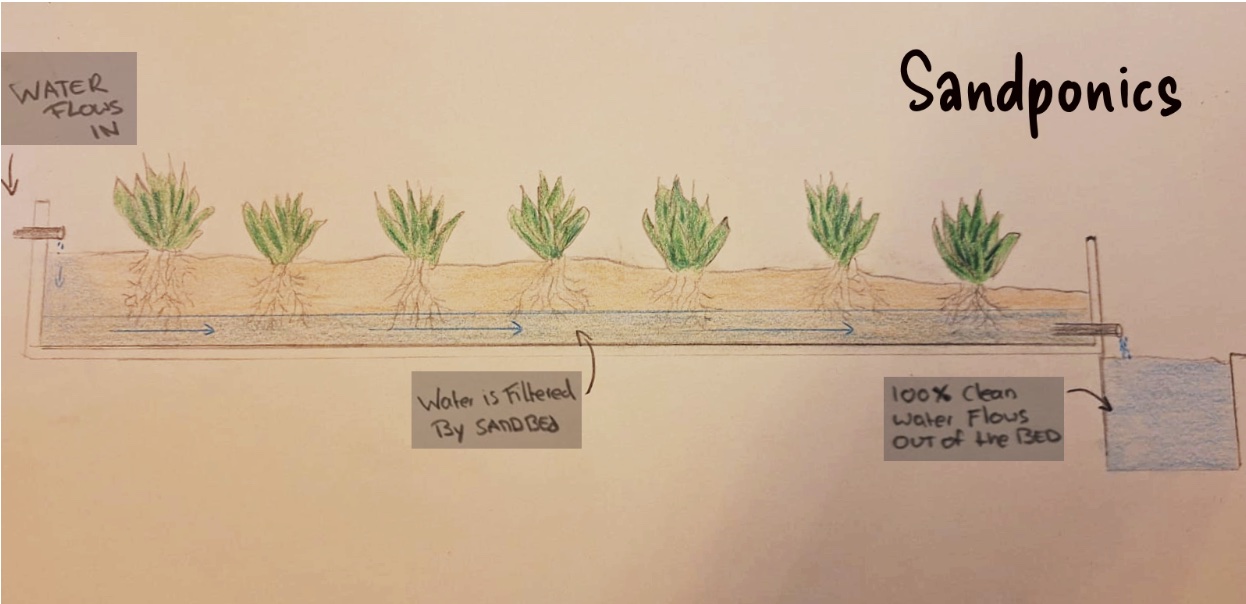
Image: The sandbed functions as our water filter. But also is our grow medium to grow plants in. The water slowly flows through the sandbed and gets filtered 100%.
At the end of the cycle, the filtered water is collected in a small channel. By this stage, the sand bed has fully purified the water, which is then returned to the fish pond through the channel. The water can be recirculated using a solar-powered pump or a non-electric vacuum pump.
ReFarm Africa | Sustainable Farming Innovations
Pioneering Techniques for Climate-change proof farming
Aquaponics
Aquaponics combines aquaculture and plant production into a single system, where fish and plants mutually benefit through improved nutrient cycling and sustainable growth.
Sandponics
Sandponics utilizes sand as a growing medium, offering a cost-effective and efficient solution for arid regions. This new technique reduces water usage while maximizing crop yield.
Resource Efficiency
Our methods prioritize the use of local resources, minimizing waste and reducing dependency on external inputs, making farming more accessible and sustainable.
Community Empowerment
By providing training and resources, we enable communities to establish their own farms, fostering economic growth and self-sufficiency.
Environmental Impact
This new farming method significantly lower the carbon footprint of farming operations, promoting a greener and more sustainable future.
Economic Opportunities
This project creates job opportunities and supports local businesses, helping to build resilient micro-economies in West Africa. We are convinced that this project is the best tool we have to fight illegal migration.
How this method will change farming
The traditional way of farming compared to our concept
Our farming method consistently outperforms traditional agriculture across the board. While conventional farming remains vulnerable to climate change, seasonal limitations, and low yields, our approach offers a sustainable alternative. Crucially, we solve the issue of high water consumption—a major flaw in traditional farming that threatens regional water security.
Traditional Farming
Harvesting depends on the season
Traditional farming in Africa is largely dependent on the seasons. Most crops rely on rainfall, so planting and harvesting follow the natural wet and dry cycles. When rains are late or unpredictable, food production and income are directly affected.
Aqua/sandponics farming
Year-round harvesting
This concept makes year-round harvesting possible by creating a controlled growing environment. Water and nutrients are continuously recycled within the system, allowing plants to grow independently of rainfall and seasonal changes. This ensures a steady and reliable food supply throughout the year.
Traditional Farming
A low crop production
Traditional farming often results in relatively low harvest yields due to its dependence on rainfall, soil quality, fertilizer and seasonal conditions.
Aqua/sandponics farming
Maximum crop production
In contrast, aquaponics techniques provide plants with a constant supply of water and nutrients in a controlled system, allowing for faster growth and significantly higher yields from the same amount of space.
Traditional Farming
Sensitive to climate change
Traditional farming often results in relatively low harvest yields due to its dependence on rainfall, soil quality, fertilizer and seasonal conditions.
Aqua/sandponics farming
Climate-change proof
Traditional farming often results in relatively low harvest yields due to its dependence on rainfall, soil quality, fertilizer and seasonal conditions.
Traditional Farming
High water consumption
Traditional farming uses large amounts of water, putting pressure on local resources. Lower groundwater levels reduce water availability, harm soil fertility, stress ecosystems, and can even cause the ground to sink or become salty, threatening both farming and communities in Africa.
Aqua/sandponics farming
90% less water usage
By reusing nearly all water in a closed-loop system, our solution cuts water use by 90%, relieving pressure on local groundwater while enabling sustainable growth. As groundwater levels return to normal, water availability improves, soil fertility is restored, ecosystems recover, and the risk of land sinking or salinization is reduced.
Traditional Farming
Extremely labor-intensive
Traditional farming is often heavy and very labor-intensive. Farmers spend long hours planting, watering, weeding, and harvesting by hand, often using minimal machinery. This physically demanding work requires significant effort while still being vulnerable to unpredictable weather, pests, and low soil fertility, which can limit both yield and income.
Aqua/sandponics farming
Low labor
Aquaponics farming can significantly ease the lives of African women. With automated water and nutrient systems, planting, watering, and maintenance require far less physical effort. It reduces the time spent on labor-intensive tasks, allowing the farmers to focus on education, family, or other income-generating activities, while still ensuring a steady and reliable food supply.
Traditional Farming
Use of toxic chemicals is common
The use of chemical pesticides is widespread but highly damaging to the soil and environment. Over time, these chemicals deplete the soil, leading to desertification. This is a serious problem affecting regions all around the world.
Aqua/sandponics farming
100% organic
The system is fully organic; chemical pesticides would be lethal to the fish. We use botanical extracts, including garlic, chili, and pepper, as natural insect repellents, maintaining a safe environment for both fish and plants.
Traditional Farming
Low yields and smaller fruits
While traditional farming served us thousands of years, its reliance on vast land use and unpredictable resources makes it a “low-yield” relic compared to the precision of aquaponics. By mimicking nature’s own filtration cycles with aquaponics, we can grow more, in less space, with a much lighter footprint.
Aqua/sandponics farming
Larger fruits and higher yields
By providing a steady flow of unlimited nutrients and water, aquaponics enables stronger growth to plants and significantly larger harvests of bigger fruits.
Traditional Farming
No fertile soil, no harvest
Healthy soil is the foundation of farming. When land is degraded, harvests disappear and farmers are pushed into crisis, a challenge affecting many regions of West Africa.
Aqua/sandponics farming
No need for fertile soil
An aquaponics farm does not need fertile soil. It can be built on places that are not fertile or areas that are slowly turning into desert.
Traditional Farming
Limited and Seasonal Employment
Traditional farming usually offers few jobs per hectare, often limited to seasonal work during planting and harvest periods, with employment that is highly dependent on weather and crop cycles. Work conditions are significantly worse compared to work conditions on aquaponics farms.
Aqua/sandponics farming
Creating sustainable income and new jobs
Aquaponics farms tend to create 2–3 times more jobs than traditional farms on the same area of land, while also providing more consistent income and better working conditions. Year-round production enables permanent employment, with jobs ranging from system operation and fish care to planting, harvesting, monitoring, processing, distribution and sales.
ReFarm Africa, Empower Youth
Our Mission
Our goal is to create a farm of the future that requires very little budget and can be used by poor communities / youths to set up their own sustainable business.
How we do it
We are ready to develop this amazing project. Years of research are done, we designed prototypes that are ready to be designed in real life!
Climate-Change Proof
Our innovative farming techniques combine aquaponics and sandponics, offering sustainable solutions that maximize yield while minimizing environmental impact.
Help us to create the Farm of the Future
Be part of a groundbreaking initiative that empowers communities through sustainable farming. Support us in transforming lives and fostering economic growth in West Africa.